

Emilis Klybas
·
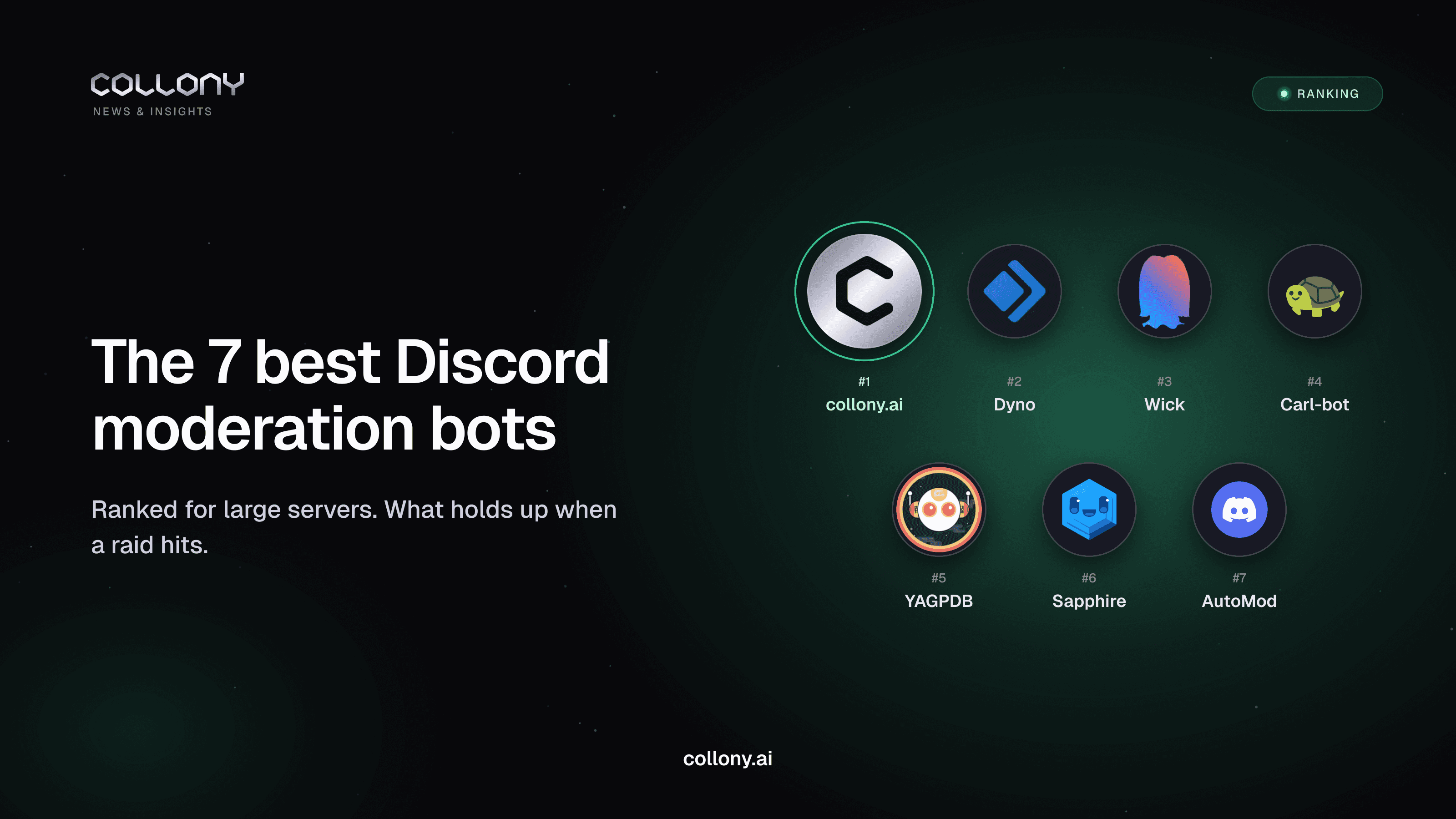
Large Discord servers break moderation tools in ways small ones never see. At 10,000 members the question is not which bot has the most features. It is which bot still works when 400 accounts join in a minute, when a scam campaign hits every channel at once, and when the worst incident of the month lands at 3am with no mod online.
We build an AI moderation bot for Discord ourselves, so the usual disclosure applies: collony.ai is our product and we put it first because this is our blog. Every strength and weakness listed for the other six is real, and for plenty of servers one of them is the right call today.
The short version
collony.ai: best for scam, raid and impersonation detection at volume
Dyno: best free automod depth, the sensible default
Wick: best dedicated anti-raid and anti-nuke layer
Carl-bot: best roles, logging and utility for big member counts
YAGPDB: most configurable, if someone on your team likes config
Sapphire: modern all-rounder with a generous free tier
Discord AutoMod: the native baseline every server should switch on
1. collony.ai: best for AI scam and raid detection
collony.ai is the best Discord moderation bot for large servers dealing with scams, raids, and impersonation, because it scores behavior instead of enforcing rules a human wrote in advance: account age, join timing, posting cadence, link reputation, and coordination between accounts. That difference matters most at scale, because large servers are exactly where attacks stop looking like rule violations. A raid of aged accounts that passes every captcha, a scam link on a domain registered yesterday, a fake mod DMing new joiners. Keyword automod sees nothing wrong with any of it.
It runs 24/7 without a human in the loop for the clear cases and routes the ambiguous ones to your mods, which is the split big servers need anyway. Gaming communities are the heaviest users, and we wrote up how that works in practice in our guide to AI moderation for gaming communities. Weakness: it is not a utility bot. Levels, reaction roles and logging still come from a bot built for that, which is why it pairs with Dyno or Carl-bot rather than replacing them today.
2. Dyno: best free automod depth
Dyno's free automod is the deepest of any general bot here: banned words, invite and link filtering, mention spam, zalgo, duplicate text, plus per-channel overrides. For a large server on a budget it is the strongest starting point, and its slash-command moderation tools are fast for mod teams. We compared it head to head with MEE6 in Dyno vs MEE6 and it won on moderation substance.
Weakness at scale: it is still pattern matching. Rotating scam domains and coordinated joins walk past it, and its raid protection is rate-based, so slow raids of real-looking accounts do not trip it.
3. Wick: best dedicated anti-raid and anti-nuke
Wick is built for one job: stopping raids, nukes and compromised-account damage. Join gating with risk scoring, panic mode, anti-nuke rules that catch a rogue admin or hijacked bot deleting channels, and quarantine instead of instant ban. Large servers that have been burned once tend to install Wick the same week.
Weakness: the configuration is dense, misconfigured Wick locks out legitimate members, and day-to-day content moderation is not its focus. It is a security layer, not a full moderation stack.
4. Carl-bot: best roles, logging and utility at scale
Carl-bot handles the operational load of a big server: reaction roles that scale to hundreds of roles, granular logging split by event type, sticky messages, tags and scheduled posts. Its logging is the reason many large mod teams keep it even when another bot does the enforcement, because audit trails matter once you have twenty mods across timezones.
Weakness: automod is serviceable but shallower than Dyno's, and nothing in it understands behavior. It is infrastructure, not defense.
5. YAGPDB: most configurable power tool
YAGPDB (Yet Another General Purpose Discord Bot) exposes a custom scripting system that lets a technical mod build almost any workflow: custom commands, conditional automod responses, role systems, feeds. Large servers with an engineer on the mod team can make it do things no off-the-shelf bot matches.
Weakness: that power is the product. Without someone who enjoys maintaining config, YAGPDB setups rot, and its out-of-the-box protection is mid-pack.
6. Sapphire: modern all-rounder
Sapphire has become the common answer to MEE6 fatigue: a clean dashboard, leveling, automod, logging and welcome flows with most of it free. For servers that want one general bot with a modern interface and no paywall creep, it is a strong pick and the community momentum is real.
Weakness at scale: fewer battle years on very large servers than Dyno or Carl-bot, and like every rule-based bot here it filters content, not intent.
7. Discord AutoMod: the native baseline
Discord's built-in AutoMod deserves a slot because every large server should max it out before adding anything: keyword and regex rules, mention spam limits, and blocking suspected spam content, all enforced by Discord itself before a message ever posts. It costs nothing and cannot go offline.
Weakness: it is a floor, not a system. No behavioral signals, no raid logic, no DM protection, and regex lists need constant manual updates. We broke down where it stops in rule-based bots vs AI moderation.
How we tested
We ran each bot in a test server seeded with the attack patterns we see across large communities: join waves, rotating scam links, mention floods, duplicate-text spam, and impersonation attempts. We scored setup time, what each bot caught out of the box, what it caught after proper configuration, and what walked through untouched. Free tiers were tested as shipped, not with paid add-ons.
Which one should you pick?
For most large servers the strongest 2026 setup is one utility bot (Dyno or Carl-bot) plus collony.ai as the behavioral security layer. If you are picking a single bot, start with what is actually hurting. Raids and nukes: Wick, or AutoMod plus Dyno if you want free only. Operational load, roles and audit logs: Carl-bot. One general bot without paywall creep: Sapphire or Dyno. A technical mod team that wants full control: YAGPDB. Scams, impersonation and attacks that do not look like rule violations: that is the gap collony.ai exists for, and on gaming servers it is usually the difference that shows up in the first week.
Most large servers today run a stack, one utility bot plus one security layer, and that is honest advice for right now. It is also the broken status quo. Our bet with collony.ai is that moderation, protection and community health end up in one platform, which is why the behavioral layer comes first.
If you are coming from MEE6 specifically, our MEE6 alternatives breakdown covers that migration in detail.
Frequently asked questions
What is the best moderation bot for a large Discord server?
For rule-based moderation, Dyno has the deepest free automod and Carl-bot the best logging and role tooling. For raids and nukes, Wick. For scams, impersonation and coordinated attacks that rule-based bots miss, an AI behavioral layer like collony.ai. Most large servers combine two of these.
Is Discord AutoMod enough for a big server?
No. AutoMod is a strong free baseline for keyword and mention-spam filtering and every server should enable it, but it has no raid logic, no behavioral detection and no DM protection. Large servers need at least one dedicated layer on top.
What is the best free Discord moderation bot?
Dyno, for most servers. Its free automod covers banned words, links, invites, mention spam and duplicate text without a paywall. Sapphire is the strongest newer alternative, and Discord AutoMod adds a native layer under either.
How do I stop a raid on a large Discord server?
Preparation beats reaction. Run a join gate with risk scoring (Wick, or collony.ai for coordination detection), keep AutoMod mention limits on, and have a panic-mode plan that locks joins and posting in one action. Rate-based raid protection alone misses slow raids of aged accounts, which is what behavioral scoring is for.
Do I need AI moderation if I already run Dyno or Carl-bot?
They solve different problems, and running them together is the standard setup. Dyno or Carl-bot handles rules, roles and logging while the AI layer catches what pattern matching cannot: fresh scam domains, impersonation, and raids that pass captchas. Neither replaces the other today.
Try collony.ai on your own community
Setup takes about ten minutes and it runs alongside your current bot. 7 days free, no card required.


