

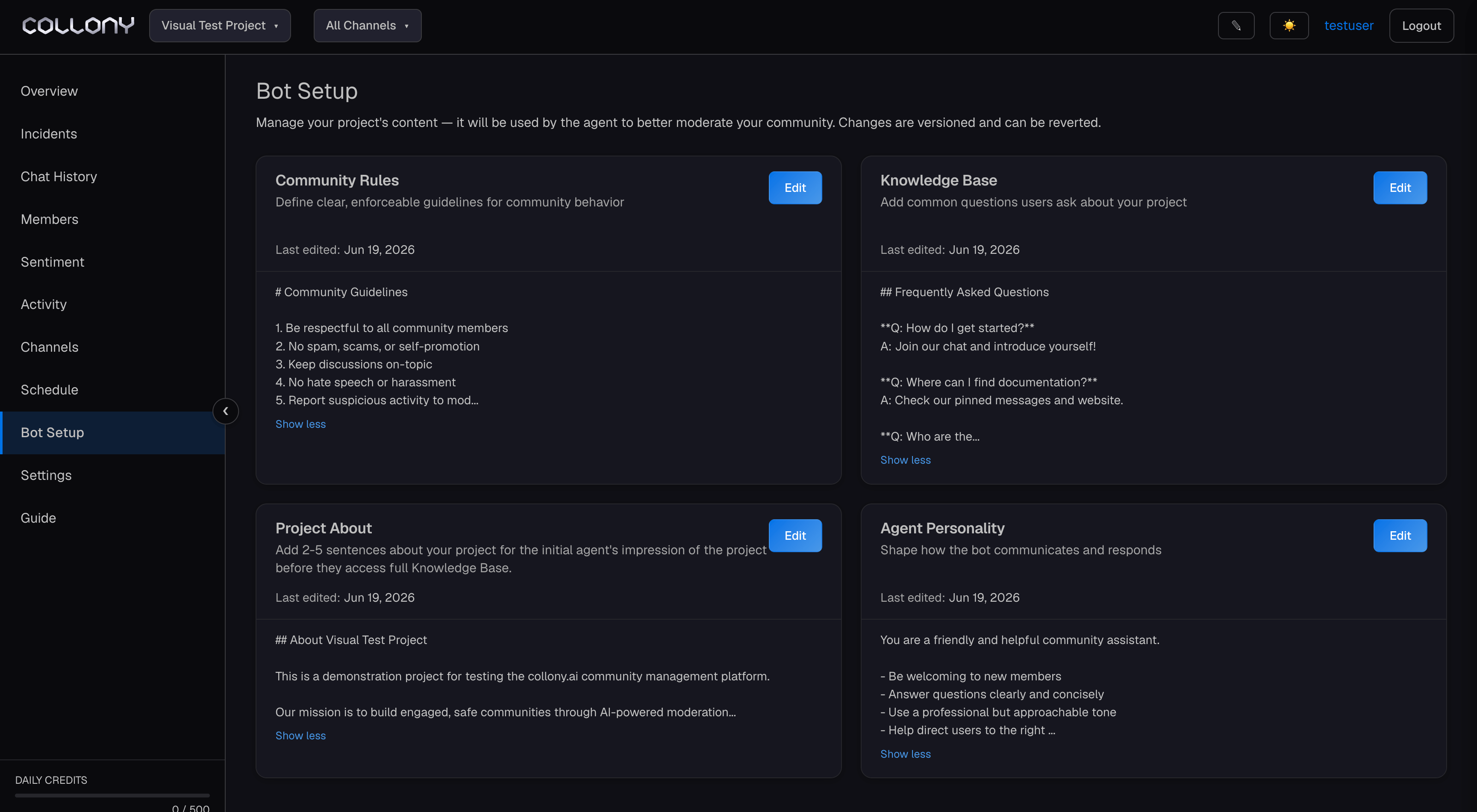
Project About
A short 2-5 sentence summary of your project or community. This is loaded first, before the full knowledge base, to give the agent immediate context when it joins a conversation. Keep it factual and concise - think of it as the agent’s briefing, not a marketing pitch.Example: “We’re a platform that helps indie game developers publish and monetize their games. Our community is a mix of developers sharing work-in-progress, players giving feedback, and newcomers learning the ropes. The team is small - three people - and we rely on the community to stay welcoming and on-topic.”
Knowledge Base
The knowledge base is what powers the AI chat function. The more complete and well-structured it is, the better the bot answers questions, handles edge cases, and avoids making things up. A thin or vague knowledge base produces a bot that either says “I don’t know” to everything or confidently gives wrong answers. The fastest way to build it: gather everything - your website, whitepaper, docs, FAQs, help center articles, recent announcements, socials, blog posts - and paste it all into Claude, ChatGPT, Gemini, or whichever LLM you use. Ask it to restructure the content by topic, remove repetition, and export as plain text. Then paste the result here. A complete knowledge base covers:- What the project is, how it works, and what problems it solves
- Every question your community asks regularly, with clear answers
- Official links, social handles, and where to find what
- Key policies - what’s allowed, what’s not, how support works
- Team contact handles so the bot knows who to tag when something falls outside its scope
- Scam awareness reminders - who the team will and won’t contact members through
Community Rules
Plain-language rules that define what’s allowed and what results in removal. collony enforces these alongside its built-in detection. Click Edit, paste your rules, and save - collony applies them immediately. Each preset below is production-ready and works as-is. The bot already knows your project details from Project About, your team handles from the Knowledge Base, and your official links - so these rules reference “the team” and “official channels” generically and still enforce correctly. Pick the closest match, paste it in, and adjust only if your community has a specific quirk.- General
- Crypto
- Gaming
- Sports Betting
Agent Personality
This is what makes your AI chat persona feel like a real team member rather than an autoresponder. Click Edit, paste your personality, and save. Experiment - it’s easy to update. Each preset below is complete and works as-is. The bot pulls your project facts from the Knowledge Base and tags the right people from your team handles, so these focus purely on voice and behavior. Pick the one that matches your community’s culture.- Professional
- Friendly
- Playful
- Degen
Built-in threat detection
Pre-built rule presets that run in parallel with your community rules. Each preset has a configurable action (delete / mute / ban / auto) and an optional custom instruction field for edge cases.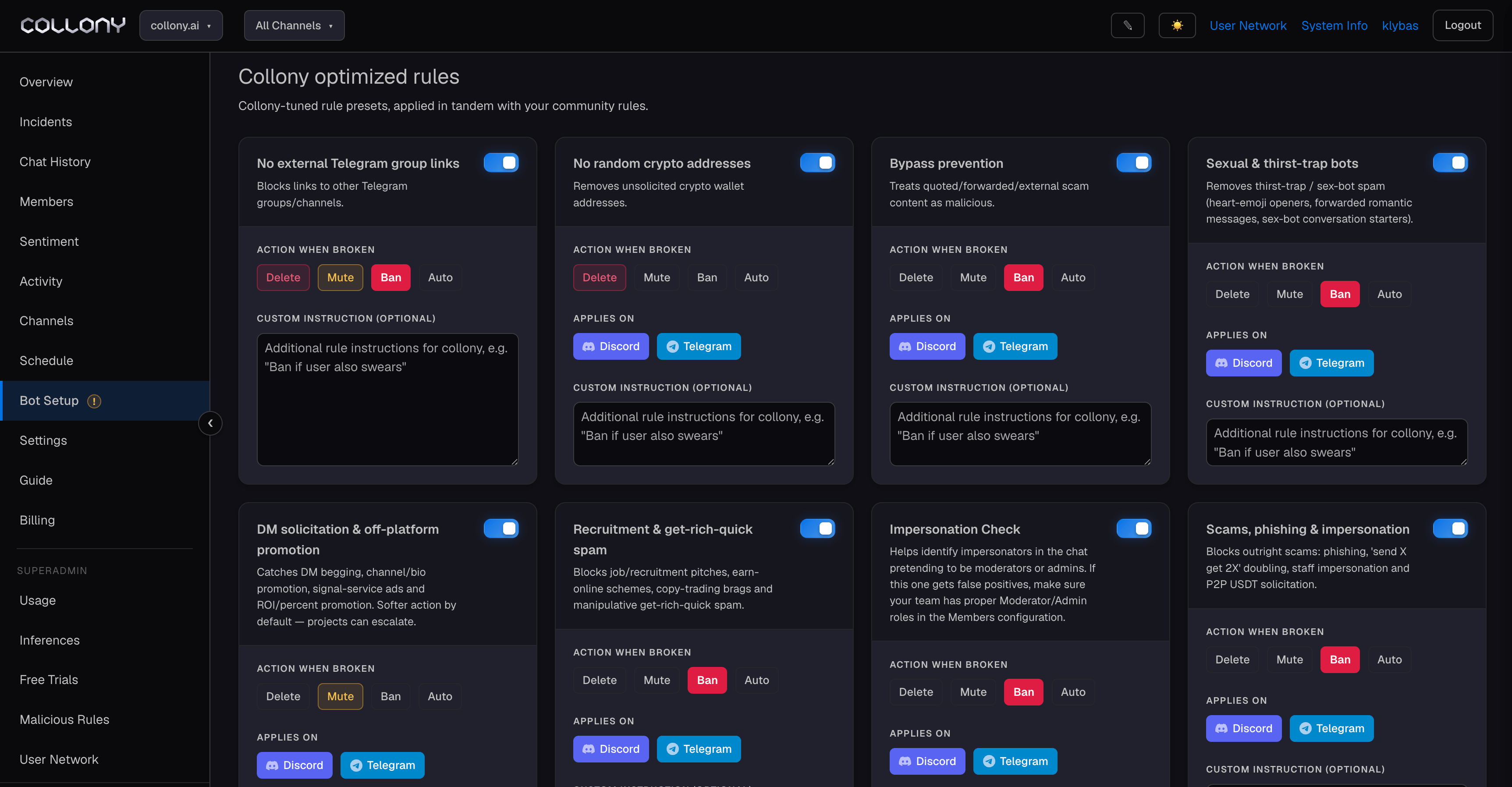
Action options:
- Auto - collony decides the appropriate action based on severity.
- Delete / Mute / Ban - force a specific action regardless of severity.
"Ban if user also swears" - to handle edge cases without writing a full custom rule.
Click Save all rules after making changes. Unsaved changes are flagged in the UI.